.png)


Home EV charging in Los Angeles and Orange County is less about the charger mounted on the wall and more about the electrical infrastructure behind it. When planning EV charger installation in Los Angeles, the difference between a smooth approval and a correction notice usually comes down to panel capacity, a complete permit package, and an inspection that satisfies the Los Angeles Department of Building and Safety or your local building department.
While Level 1 charging can work in limited situations using a standard outlet, most homeowners rely on Level 2 charging to restore driving range overnight.
A compliant home charging setup must meet several electrical and energy code requirements. Installations typically follow NEC Article 625 along with California energy standards such as Title 24 and CALGreen.
A standard installation usually includes:
These requirements ensure that the system operates safely and meets inspection standards.
Installing an EV charger typically requires an electrical permit and inspection. The process ensures that wiring, equipment selection, and installation practices meet both national and local safety codes.
During the permitting process, inspectors review factors such as:
Passing inspection depends on clear documentation and a correctly installed electrical system.
Before installing a Level 2 charger, electricians often perform a whole-home electrical load calculation. This evaluation determines whether the existing panel and service can support the additional load.
Depending on the results, several solutions may be recommended:
Load calculations help ensure that EV charging can operate safely without overloading the electrical system.
For homeowners in communities with homeowners associations charger installations may require approval for equipment placement or exterior wiring.
Utilities in Southern California may also influence the overall cost of charging. Both LADWP and Southern California Edison offer programs that include incentives, rebates, or time-of-use electricity plans designed for EV owners.
These programs can significantly affect the long-term cost of charging at home.
The most reliable way to plan a home charging system is to begin with the electrical service and panel. Understanding available capacity makes it easier to determine whether the charger can be installed directly or whether upgrades are needed.
From there, electricians design the circuit, obtain permits, and complete the installation in a way that meets local code and inspection requirements.
With a properly planned electrical system, installing a home EV charger becomes a straightforward path to reliable overnight charging and convenient everyday driving.
For most Los Angeles and Orange County households, the right home charging level comes down to two factors: how many miles you drive on a typical day and how many hours your vehicle sits at home overnight. Here is how Level 1, Level 2 (32A, 40A, and 48A), and the rare residential DC fast option translate into real range recovery for local commuting patterns.
Typical portable chargers at 12A deliver roughly 1.4 kW, which adds about 3 to 5 miles of range per hour, assuming 3 to 4 mi/kWh efficiency. Over an 8-hour overnight window, that works out to about 24 to 40 miles of recovered range. This can be enough for light-use drivers or a second vehicle, but it becomes tight for 45 to 60-mile round trips unless you can stay plugged in for 12 or more hours each night.
Common Level 2 charging outputs and practical speeds include:
Across an 8-hour overnight charging session, a 32A charger can replenish roughly 185 to 250 miles of range. That is more than enough for most LA and OC commutes, errands, and next-day readiness.
EV charging is considered a continuous load, so the breaker must be sized at 125% of the EVSE rating. In practice, that means:
This breaker mapping matters when evaluating panel capacity and often influences the final recommendation, especially for homes with 100A service where a 40A setup may be the more practical fit.
Many EVs accept between 7.2 and 11.5 kW AC charging. If your vehicle’s onboard charger tops out at 7.2 kW, a 48A wall unit will not charge faster than a 32A (7.7 kW) unit. Before paying for higher amperage, check your vehicle’s AC charging specification and make sure you are choosing a setup your current or future vehicle can actually use.
For a 30-mile driving day:
For a 45-mile driving day:
For a 60-mile driving day:
These ranges reflect a 3 to 4 mi/kWh efficiency spread across common EVs.
In older Los Angeles bungalows or detached-garage setups where panel space and feeder paths are limited, 32A or 40A is often the best balance between charging speed and installation complexity. In newer Orange County homes with 200A service and shorter conduit runs, 48A can make sense, especially for households planning for two EVs or frequent late-evening top-ups.
Off-peak and overnight time-of-use windows from LADWP, SCE, and many municipal utilities reward scheduled charging. In many cases, a 32A charger running during super off-peak hours can outperform a higher-amp unit used during peak periods when total charging cost and carbon intensity are factored in, all without sacrificing next-day readiness.
DC fast charging at home requires high-power electrical service, utility coordination, and specialized equipment that far exceed normal residential budgets and permitting standards. For the vast majority of households, a properly sized Level 2 charger is the faster, quieter, and more grid-friendly solution.
Before selecting a charger size, your home’s electrical service must be evaluated. In Los Angeles and Orange County, the difference between a smooth installation and a stalled project often comes down to a single question: can the panel safely carry a new continuous load for several hours every night?
Under NEC Article 625, EV charging is classified as a continuous load. This means the circuit must be sized so the breaker is at least 125 percent of the charger’s output. In practical terms:
This requirement determines branch-circuit sizing. The broader service calculation answers a different question: when all of the home’s real-world loads stack up, lighting, appliances, HVAC, how much electrical capacity remains for the vehicle charger?
Electrical service varies widely across Southern California housing stock.
Many Los Angeles homes built between the 1940s and 1960s still operate on 100-amp service. Newer tract homes constructed in the past two decades in cities such as Irvine, Mission Viejo, and Yorba Linda more commonly have 200-amp service.
Both can support Level 2 charging, but the installation approach may differ.
A typical site evaluation includes:
Once these details are gathered, a load calculation models the home’s demand. The dwelling calculation applies demand factors to general lighting and small-appliance circuits, adds major loads such as air conditioning or an electric range, and includes the EV charger as a continuous load.
Within minutes of running these numbers, the project path usually becomes clear: proceed with installation, add a subpanel, or consider a service upgrade.
Consider a 1954 bungalow in Highland Park with:
After applying demand factors, the base dwelling load often lands in the mid-single kilowatt range. When the air conditioner and dryer are included, the combined demand may reach roughly 12 to 14 kW.
A 32-amp EV charger adds about 7.7 kW of continuous load. Since a 100-amp service at 240 volts can supply roughly 24 kW, the installation may still fall within capacity.
In practice, the electrician will confirm:
For homes like this, a hardwired 40-amp circuit set to deliver 32 amps is often recommended. This configuration provides strong overnight charging performance while maintaining headroom during peak evening loads when the air conditioner is running.
If the homeowner prefers a 48-amp charger, the service can approach its limit. In those cases, an EV energy management system can be the difference between approval and requiring a costly service upgrade. By monitoring household demand and reducing charging speed when large appliances run simultaneously, the EVEMS allows the charger to ramp back up later at night.
Now consider a newer Orange County home in Ladera Ranch with:
In many cases, the load calculation easily accommodates a 60-amp EV circuit. Because capacity is less constrained, future-proofing becomes the smarter strategy.
A common approach includes:
If the main panel is located far from the garage, installing a small garage subpanel can also reduce costs long term. Feeding that subpanel with a 60- to 100-amp breaker shortens future wiring runs, creates breaker space near the vehicles, and avoids additional wall or landscaping disruption later.
Planning for a second EV during the first installation almost always costs less than adding infrastructure later.
Not every EV installation requires a service upgrade. In many older LA neighborhoods, the main service may be adequate but the panel itself is outdated or overcrowded.
Replacing the panel with a modern 100-amp load center can:
In other situations, such as homes with pools, spas, resistance heating, or major electrification upgrades, moving to a 200-amp service may be the better long-term investment. Service upgrades require coordination with the utility and can extend project timelines, so the decision is weighed carefully against the actual load requirements.
Modern EV chargers provide additional flexibility. Some models support power-sharing, allowing two vehicles to charge from the same circuit.
For example, two wall connectors on a shared 60-amp feed can automatically divide available power:
Energy management systems also help installations fit within existing service limits.
In one Anaheim Hills project, a homeowner wanted a 48-amp charger on a 100-amp service already stressed during summer evenings. By configuring the EVEMS to limit charging to 16 amps while the air conditioner was running and allowing the charger to ramp up to 48 amps after 10 p.m., the system remained within service limits while still delivering a full overnight charge during off-peak hours.
This type of smart load management aligns hardware, utility rate schedules, and real driving patterns into a single efficient system.
Every successful EV charger installation in Los Angeles or Orange County begins with a proper load calculation. It protects the home’s electrical system, determines the correct breaker and conductor sizes, and clarifies whether additional equipment, such as a subpanel, EVEMS, or service upgrade, is needed.
Once the electrical capacity picture is clear, the rest of the process becomes straightforward: permitting, code requirements such as GFCI protection and enclosure ratings, and final inspection.
Understanding these fundamentals ensures your EV charging setup is safe, compliant, and ready for future vehicles.

The right charger, mounting approach, and installation location make daily charging simple and reliable in Los Angeles and Orange County homes. Climate conditions, garage layouts, and electrical infrastructure all influence what equipment will perform best over time. When planning EV charger installation in Los Angeles, homeowners should match the charger and installation method to the property’s layout, exposure to weather, and current or future vehicle needs.
A 1928 Spanish-style home in Highland Park had a detached stucco garage located roughly 55 feet from the main electrical panel. The homeowner drives about 45 miles per day and wanted a 40A Level 2 circuit with flexibility for a second EV in the future.
The installation used a 48A-capable wall unit configured to run at 40A. Because the garage faces occasional wind-driven rain, a NEMA 4X-rated enclosure was selected. The charger was mounted near the garage door to improve cord reach for both driveway and interior parking, and EMT conduit was routed along the side yard to avoid unnecessary stucco patching. Wi-Fi scheduling was enabled so charging automatically runs during off-peak hours.
This layout avoided a panel upgrade while minimizing trenching and wall repairs.
For 40A charging and above, hardwired installations are usually the better long-term choice. Hardwiring reduces heat at electrical connections, eliminates a plug interface, and improves durability for outdoor setups.
A NEMA 14-50 receptacle works well for portable EVSEs, but many Los Angeles jurisdictions require GFCI protection on garage receptacles. That requirement can sometimes cause nuisance tripping with EV chargers. Hardwiring avoids that issue while creating a cleaner, more reliable installation.
Most residential EV chargers include cables between 18 and 25 feet long. Placement should allow the connector to reach the vehicle’s charge port without stretching across walkways or drive paths.
In many Los Angeles driveways where parking space is tight, mounting the charger near the garage door works well. It allows the cable to reach vehicles parked inside the garage or just outside in the driveway.
Before choosing the location, consider:
Planning this carefully makes daily charging much easier.
Outdoor installations require weather-resistant equipment. Chargers mounted outside should have at least a NEMA 3R enclosure rating.
In coastal environments such as Huntington Beach, Newport Beach, or San Pedro, higher protection is recommended. NEMA 4X enclosures or stainless mounting hardware help resist salt exposure and corrosion.
In hotter inland areas such as the San Fernando Valley or Santa Clarita, heat management becomes more important. Installing the charger in shaded areas and avoiding west-facing walls helps prevent overheating during late afternoon sun.
Charging connector standards are currently shifting across the EV market. Many newer vehicles now use the North American Charging Standard, while some vehicles still rely on CCS connectors and adapters.
Some chargers, such as Tesla Wall Connector units, can serve multiple vehicle types using compatible adapters. Before selecting equipment, verify your vehicle’s charging port and choose a charger that supports either your current connector type or future compatibility.
Shorter wiring paths reduce both installation complexity and overall cost. Mounting the charger on the wall closest to the electrical panel, or on the house side of a detached garage, often saves hundreds of dollars in trenching, conduit, and patch work.
In the Highland Park example, running EMT conduit along an exterior side yard walkway preserved the garage’s interior walls while keeping the wiring route dry and easily accessible for inspection.
Strategic placement can significantly reduce:
Modern EV chargers often include smart features that improve both convenience and electrical efficiency.
Wi-Fi scheduling allows charging sessions to align with off-peak electricity rates offered by LADWP and Southern California Edison. Many chargers also support load sharing, allowing two vehicles to charge from the same circuit if a second EV is added later.
If a home’s electrical panel is close to capacity, an EV energy management system can limit charging current when other appliances are running. This approach helps installations stay within existing service limits while still providing reliable overnight charging.
Choosing the right charger equipment and installation location from the start helps ensure the system remains safe, code-compliant, and easy to use for years. Once the layout and equipment are defined, the next step is building a realistic budget and timeline for EV charger installations across the Los Angeles and Orange County market.
For most homeowners, the real decision is not whether a charger can be installed but which approach delivers the right result with the least disruption. Costs and schedules in Los Angeles and Orange County vary widely based on the distance between the electrical panel and parking location, whether the garage is attached or detached, and whether the existing electrical service can support a continuous 32–48A charging load. Comparing a simple installation to a longer run or detached-garage setup highlights where both costs and timelines tend to shift.
In the most straightforward case, an attached garage with the panel on the same wall and a 40A charging circuit, the project is typically a focused one-day installation.
Typical project components include:
Total project cost usually falls between $1,400 and $3,000.
Timelines are generally short. A site visit can often occur within a few days. Permits in Los Angeles City are frequently issued the same or next day, installation takes half to a full day, and inspection typically occurs within 2 to 5 business days. Many homeowners are charging their vehicle within one to two weeks of starting the process.
Costs and timelines change when the parking location is farther from the electrical panel, such as a detached garage or carport located 60 to 90 feet away.
In these situations, trenching, longer conduit runs, and possibly a small subpanel become necessary.
Typical cost ranges may include:
These installations typically land between $4,000 and $9,000.
If the electrical load calculation requires upgrading to a 200-amp service, homeowners should plan for an additional $3,000 to $7,000 plus coordination with the utility company. That upgrade can extend the project timeline depending on scheduling.
Detached-garage installations typically take two to four weeks from start to finish. If a service upgrade or homeowner association approval is required, timelines can extend to three to six weeks.
Several design decisions can influence both price and installation complexity.
Choosing a 40A charging setup instead of 48A can reduce costs because a 40A EV charger uses a 50A breaker, while a 48A charger requires a 60A breaker and heavier wiring. These differences become significant when conduit runs are long.
Hardwired chargers are often more cost-stable for higher-amperage installations. In many areas, installing a NEMA 14-50 receptacle requires an expensive GFCI breaker under current code requirements, which can offset the flexibility of a plug-in connection.
Load management devices can also influence project cost. These systems typically cost $300 to $800 plus installation but may allow the charger to operate within the home’s existing electrical capacity and avoid a costly service upgrade.
Routing choices matter as well. Running conduit externally along a wall in painted EMT conduit is often less expensive than fishing wiring through finished interior walls. Even shortening the run by 20 to 30 feet through strategic charger placement can reduce materials and labor costs by several hundred dollars.
Permitting processes vary slightly between Los Angeles and Orange County jurisdictions.
In Los Angeles City, many single-family EV charger installations qualify for the Electrical Express permit program. This allows permits to be issued the same day with relatively quick inspections, helping many projects stay within a two-week timeline.
Orange County cities often have similar processes, but projects involving trenching, detached garages, or subpanels may require plan review, which can add several days.
Homeowner associations in master-planned communities may also require drawings, contractor insurance documentation, or architectural review approval. This process can add one to four weeks before installation work begins.
For homeowners considering EV charger installation in Los Angeles or Orange County, the biggest drivers of cost and timeline are distance from the electrical panel, desired charging amperage, and available electrical capacity.
Starting with a proper load calculation and a placement plan that minimizes conduit runs often produces the best results. From there, deciding whether a slightly lower amperage, a hardwired connection, or a load-management system makes sense can keep the project within the home’s existing electrical service while maintaining a shorter installation timeline and full code compliance.
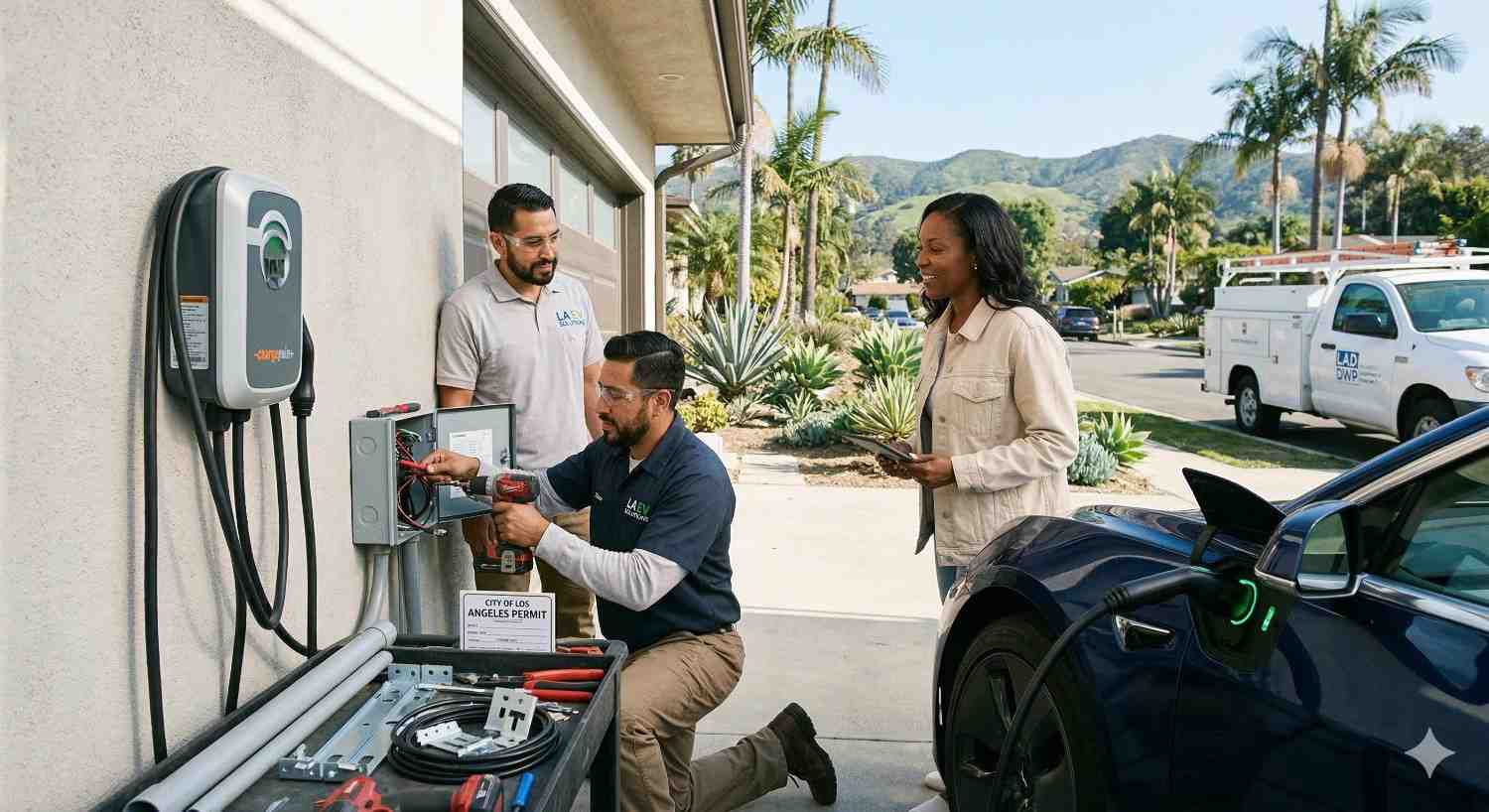
A well-installed EV charger can still cost more to operate if utility rates and incentive programs are overlooked. Across Los Angeles and Orange County, several common mistakes lead to higher electricity bills or missed rebates. Understanding these pitfalls, and how to avoid them, helps homeowners keep both costs and paperwork under control.
Many homeowners install a charger but remain on a default tiered electricity plan or forget to schedule charging during off-peak hours. The result often appears as unexpectedly high summer electric bills.
Fix: Enroll in your utility’s time-of-use rate plan through LADWP or Southern California Edison and set your charger or vehicle to charge overnight.
A simple charging schedule such as 9 p.m. to 7 a.m. typically captures the off-peak window and easily replenishes the energy needed for a 30–60-mile daily commute.
Many rebate programs require pre-approval or restrict eligibility to certain charger models. Some also require proof of permits and inspections. Purchasing equipment before reviewing program requirements can make the installation ineligible.
Fix: Before ordering equipment, review the rules from your local utility such as LADWP, Southern California Edison, or Anaheim Public Utilities. Confirm:
Always keep dated receipts and the permit number, since rebate programs often request both.
Recent changes to the federal Alternative Fuel Infrastructure Tax Credit (Section 30C) restrict eligibility to installations located within specific census tracts, typically low-income or non-urban areas. Many homes in Los Angeles and Orange County do not meet this requirement.
Fix: Check your address using the official eligibility map before relying on the federal credit in your project budget. If your property does not qualify, focus on local incentives and time-of-use savings instead.
Homeowners with solar sometimes assume nighttime EV charging will always be cheapest. Under California’s NEM 3.0 rules, however, solar export values are much lower than in previous programs.
This means exporting excess solar power during the day and buying electricity back at night may cost more than simply charging during solar production hours.
Fix: Shift some charging sessions to midday when your solar system is producing power. Many smart chargers offer solar-tracking features that automatically increase charging when solar generation is high.
For example, moving a 10 kWh charging session to midday solar hours can often cost less than exporting that power and purchasing energy later at night.
Public Level 2 or DC fast charging stations often appear convenient, especially when apps promote discounted sessions. However, public charging rates, and potential idle fees, typically exceed the cost of home charging during off-peak hours.
Fix: Use home charging as your primary fueling method and treat public chargers as backup or road-trip options. Comparing your home’s off-peak electricity rate with prices shown in charging network apps usually reveals a significant cost difference.
Many rebate programs require documentation confirming the installation was permitted and inspected. Missing paperwork can delay or invalidate rebate applications.
Fix: Always pull the proper permit and keep records of the inspection approval. Save the final inspection documentation, such as the LADBS job card or the city’s permit close-out confirmation, and submit it along with your rebate application.
For EV charger installation projects in Los Angeles, utilities commonly reject rebate claims that lack this documentation.
Choosing the right electricity rate plan, confirming rebate eligibility before purchasing equipment, and maintaining proper permit documentation can significantly reduce both upfront and long-term EV charging costs. A few minutes spent checking rates and incentives before installation often pays for itself within the first several months of home charging.
A common assumption among EV owners is that once rooftop solar and a home battery are installed, EV charging becomes essentially “free.” The idea sounds simple: generate solar power during the day, store it in the battery, and charge the car whenever needed using that stored energy.
In practice, California’s current energy rules make the situation more nuanced. Under the state’s updated solar policies, charging strategy and timing matter far more than simply installing the largest charger available.
Under California’s Net Energy Metering 3.0 rules, the value of exporting solar energy back to the grid is significantly lower than the price homeowners pay to buy electricity later. Export credits are often only a few cents per kilowatt-hour, while retail electricity prices can be several times higher depending on the time of day.
Because of this difference, using your solar power directly in the home, known as self-consumption, usually produces better savings than sending it back to the grid.
This is why EV charging strategy becomes important. Charging during daylight hours when solar panels are producing energy often makes more financial sense than exporting that electricity and buying power back later at higher evening rates.
Another common misunderstanding is assuming that a home battery can easily power both the house and the car overnight.
In reality, most residential battery systems are sized primarily for home backup and load balancing rather than EV charging. A typical battery stores around 13.5 kWh of energy. A daily commute of 40 to 60 miles, however, often requires roughly 12 to 18 kWh of electricity depending on vehicle efficiency.
If that same battery is also supporting evening household loads such as lighting, cooking, and HVAC, the stored energy may not last through both the home’s needs and the vehicle charging session.
Charging power also plays a role. A 48-amp Level 2 charger can draw roughly 11.5 kW. At that rate, a typical 13.5 kWh battery could be depleted in about an hour if the car is charging directly from stored energy.
Once the battery is drained, the remaining charging session draws power from the grid, often during mid-peak or peak pricing periods depending on the time of day.
This is why maximizing charger size alone does not necessarily reduce energy costs.
For many households in Los Angeles and Orange County, a mixed charging schedule delivers better results.
Imagine a home with:
If the car is home during the day, midday solar production can often deliver 15 to 20 kWh directly into the vehicle battery. That energy would otherwise be exported to the grid at a much lower value.
On typical workdays when the vehicle is away during daylight hours, scheduling charging to finish during late-night off-peak periods helps capture lower electricity rates.
Another important factor is charging speed. Slower charging rates often align better with both solar output and household electrical capacity.
Reducing charging speed to 24 to 32 amps can:
Even at those lower charging speeds, most vehicles can recover 30 to 60 miles of range within two to three hours, more than enough for typical LA and Orange County commuting patterns.
The biggest savings do not come from installing the highest-amperage charger available. They come from coordinating charging behavior with solar production, battery capacity, and time-of-use electricity pricing.
Planning EV charger installation in Los Angeles or Orange County around realistic driving needs, solar generation patterns, and off-peak utility windows often produces lower long-term operating costs than simply prioritizing maximum charging speed.
Smart scheduling and load management allow your existing solar and electrical system to function as a much more efficient fueling plan.
Home EV charging does not need to be complicated. With thoughtful planning and a licensed electrician, homeowners can add reliable, code-compliant charging capacity that fits their daily driving patterns and electrical infrastructure. The most successful installations balance charger level and amperage with the limits of the home’s electrical panel, secure proper permits and inspections, and place equipment where it is convenient for everyday use while leaving room for future expansion.
Local incentives and utility programs can also reduce upfront costs when handled correctly. Taking the time to confirm eligibility, select approved equipment, and document permits and inspections helps ensure those savings are not missed. Because electrical codes and permitting processes can vary between municipalities, EV charger installation in Los Angeles often requires familiarity with both Los Angeles city requirements and neighboring Orange County jurisdictions.
Adding EV charging is not simply about choosing the right hardware. It involves safe electrical capacity planning, proper routing of wiring and conduit, permitting, and in some cases site lighting that improves visibility and safety around parking areas. Addressing these elements early in the project helps prevent delays, change orders, or inspection issues later.
For homeowners, multifamily property managers, and commercial property owners considering EV charger installation in Los Angeles, working with experienced local electricians helps keep the project compliant, efficient, and aligned with regional building standards. The right electrical partner ensures the system is designed for reliable charging today while remaining flexible for future EV growth.
NQ Electric serves Los Angeles and Orange County, covering most surrounding cities. We handle residential, commercial, and industrial lighting projects across these counties. For larger sites just outside the area, contact us and we can confirm availability.
We design, install, upgrade, and maintain lighting systems for homes, businesses, and industrial facilities. Our projects include new fixtures, recessed lighting, LED retrofits, and lighting control systems such as dimmers, occupancy and vacancy sensors, daylight sensors, and timers. We also install and service outdoor lighting, security lighting, parking lot lighting, and warehouse lighting.
An LED retrofit replaces existing lamps or fixtures with energy-efficient LED equivalents. In many cases, drivers and lighting controls are also updated to match the new fixtures. LED lighting can significantly reduce energy use and lower maintenance needs compared with older technologies. Light quality often improves as well, with better color rendering and more consistent illumination. Payback periods typically range from one to three years depending on operating hours, energy rates, and available incentives.
Many lighting installations and circuit changes in California require permits and inspections, particularly in commercial environments. NQ Electric manages the permitting process and coordinates inspections when required. This ensures the work is documented and compliant with local electrical codes and Title 24 lighting requirements.
In many situations, yes. We evaluate the compatibility of your existing fixtures and wiring, then install controls such as dimmers, occupancy or vacancy sensors, daylight sensors, and timers. Properly selected controls can improve comfort, reduce unnecessary runtime, and help meet energy code requirements.
Yes. We install and service wall packs, floodlights, pole lights, area lighting, and high-bay fixtures. Systems may include photocells, motion sensors, and other controls designed to improve efficiency and security. For larger areas, we recommend lighting layouts that achieve appropriate light levels while minimizing glare and light spill.
Our work follows the California Electrical Code and applicable sections of Title 24 governing lighting power allowances and controls. Installations include proper grounding, labeling, and overcurrent protection, and we use listed components that meet safety standards. When required, we obtain permits and complete inspections to verify compliance.
Local utilities often offer incentives for qualified LED fixtures and lighting controls. These programs are subject to eligibility requirements and may require pre-approval. Customers frequently apply through LADWP or Southern California Edison. We can help document the fixtures and controls used in your project to support rebate applications.
