.png)

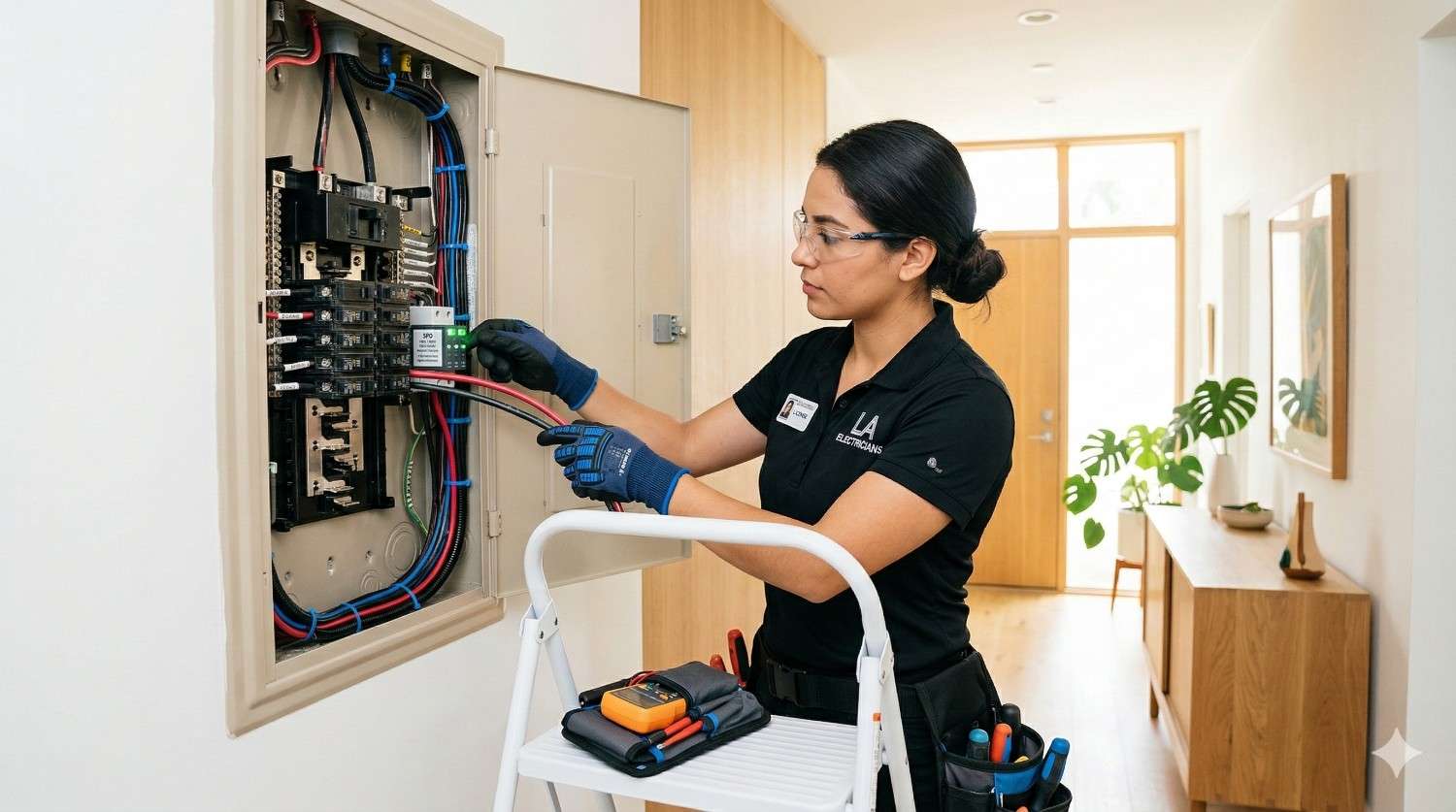
Los Angeles power systems face stress from more than just storms. Heatwaves, utility switching, wildfire-related shutdowns and restorations, and nearby construction can all introduce sudden voltage spikes into neighborhood electrical lines. Inside the home, large appliances such as air conditioners, refrigerators, EV chargers, and other motor-driven equipment create smaller but frequent surges each time they cycle on or off.
Over time, these electrical transients gradually damage circuit boards, power supplies, and sensitive electronics. The result can be shortened equipment lifespan, intermittent failures, or, in extreme cases, elevated fire risk. This is why whole house surge protection Los Angeles homeowners search for has become an increasingly important upgrade. A properly specified surge protective device, installed at the electrical panel and listed to UL 1449 standards, helps clamp dangerous voltage spikes and redirect them safely to ground before they reach household circuits.
Many people rely on plug-in power strips with basic surge protection, but those devices only protect the specific outlets they serve. They also cannot stop large voltage spikes entering through the main electrical service.
A whole-home surge protective device is installed directly at the electrical panel, allowing it to intercept incoming surges before they spread through the home’s wiring. From that central location, the device helps shield every circuit connected to the panel, including lighting, appliances, HVAC equipment, and sensitive electronics.
Power strips can still play a useful role, but they are typically considered a secondary layer of protection rather than the primary defense.
Modern electrical standards often recommend a layered approach to surge protection. This strategy combines different device types so that voltage spikes are reduced in stages before reaching sensitive equipment.
In residential systems, this approach typically includes:
This layered structure aligns with guidance found in the National Electrical Code, the California Electrical Code, and typical installation practices reviewed during Los Angeles Department of Building and Safety inspections.
Panel-mounted surge protectors are designed to reduce voltage spikes caused by utility switching, nearby lightning activity, or internal electrical loads cycling on and off. By limiting the magnitude of these surges, they help protect equipment such as computers, televisions, appliances, and smart home devices.
However, surge protection devices do not eliminate all electrical risks. Extremely large lightning strikes or severe power disturbances may still overwhelm protection systems. Surge devices also cannot correct issues such as improper grounding, overloaded circuits, or faulty wiring.
For best results, surge protection should be installed as part of a properly grounded and code-compliant electrical system.
Not all surge protection devices perform the same way. Several technical specifications influence how effectively a device can handle electrical transients.
Important considerations often include:
Higher-quality devices typically offer stronger surge current ratings and more durable internal components designed for repeated transient events.
Modern Los Angeles homes increasingly include solar panels, battery storage systems, and electric vehicle charging equipment. Each of these technologies introduces additional electronics that can be sensitive to voltage disturbances.
Surge protection strategies should account for these systems by ensuring that both the main electrical service and any dedicated subpanels or inverters have appropriate protection.
For example, solar inverters often benefit from surge protection installed on both the AC and DC sides of the system, while EV charging circuits may require additional protective considerations depending on the charger design.
Whole-home surge protectors are typically installed inside or adjacent to the main electrical panel by a licensed electrician. Installation may involve connecting the SPD to a dedicated breaker or directly to the service bus, depending on the device type and panel configuration.
Costs vary depending on panel layout, device rating, and labor requirements, but the installation is generally considered a relatively small upgrade compared with the cost of replacing damaged electronics or appliances.
Like many electrical protection devices, surge protectors also have a finite lifespan. Repeated surge events gradually wear down internal components. Many modern devices include indicator lights that show whether the protection is still active, allowing homeowners to replace the unit if it reaches the end of its service life.
Panel-mounted surge protection acts as the first line of defense for every circuit in the home. By intercepting voltage spikes at the electrical panel, it helps reduce the risk of damage to appliances, electronics, and smart-home systems across the entire property.
Understanding how these devices work and how they integrate with modern electrical systems, makes it easier for homeowners to decide whether surge protection should be part of their overall electrical safety strategy.
Los Angeles operates on one of the largest and most complex urban electrical grids in the United States. The way this system responds to heat, wildfire precautions, infrastructure changes, and modern electrification helps explain why voltage spikes and electrical transients are relatively common in the region. Understanding these local conditions helps homeowners choose surge protection that aligns with how power is actually delivered across Los Angeles neighborhoods.
Hot afternoons in Southern California often cause electricity demand to rise rapidly as air conditioning systems run continuously across the region. When demand climbs quickly, utilities perform normal grid-balancing operations such as switching capacitor banks, adjusting transformer taps, and reconfiguring distribution feeders.
These actions help maintain stable voltage across the network, but each switching event can produce a brief electrical transient that travels along service lines and into residential panels. During severe heatwaves, grid operators frequently rebalance power to maintain reliability. In practice, these frequent adjustments mean that many surge events originate from routine grid operations rather than rare incidents.
In parts of Los Angeles County served by Southern California Edison, utilities sometimes implement Public Safety Power Shutoffs during high wildfire risk conditions. Both Southern California Edison and LADWP also regularly restore power following maintenance work, storm damage, or equipment faults.
When power is restored to long distribution lines or entire neighborhoods, electrical systems experience inrush current and sudden voltage transitions. These brief events may only cause lights to flicker, but sensitive electronics can still detect the spike. Restoration events are essential for safety and reliability, yet they are also moments when voltage transients are most likely to occur.
Much of Los Angeles housing was built in the mid-20th century, and many homes still rely on electrical systems designed long before modern electronics became common. Older panels, aging grounding systems, or worn bonding connections can allow more surge energy to pass through a home’s wiring.
At the same time, modern homes contain far more electronic equipment than earlier generations. Variable-speed HVAC systems, smart appliances, networked devices, and entertainment systems rely on sensitive semiconductor components that are more vulnerable to electrical disturbances.
This combination, older electrical infrastructure paired with modern electronics, makes panel-level surge protection especially valuable in many Los Angeles homes.
Southern California experiences far fewer lightning strikes than many other regions of the United States. As a result, the surge profile in Los Angeles tends to be dominated by equipment switching and grid operations rather than lightning events.
In practical terms, most surge events in LA are relatively small but occur frequently. They may not be dramatic enough to trip breakers or cause obvious failures, yet repeated exposure can gradually degrade electronics and appliance control boards over time.
Effective surge protection in this environment focuses on rapid clamping response, low let-through voltage, and strong grounding connections rather than protection against rare lightning strikes alone.
Los Angeles has become one of the leading cities in the United States for rooftop solar installations. Solar inverters, battery systems, and electric vehicle charging equipment all introduce additional electronics and switching events within residential electrical systems.
Solar inverters regularly convert energy between direct current and alternating current, while battery storage systems manage charge and discharge cycles. Electric vehicle chargers, particularly Level 2 systems, introduce significant cyclical electrical loads.
These technologies improve energy efficiency and electrification but also create additional moments where voltage fluctuations can occur within the home’s electrical system.
When combined with traditional motor loads such as HVAC systems and refrigerators, homes can experience numerous small electrical transients throughout the day.
Research from electrical standards organizations indicates that a large portion of surge events originate from inside the building itself as appliances and equipment cycle on and off. The remaining events typically enter through utility service conductors.
Most of these surges are small enough that they do not trip breakers or create immediate damage. However, repeated exposure can gradually wear down sensitive components in devices such as routers, smart thermostats, televisions, and appliance control boards.
Because these failures often appear as gradual wear rather than a single catastrophic event, homeowners may end up replacing electronics without realizing that cumulative surge damage played a role.
For homeowners evaluating whole house surge protection Los Angeles options, this local reality often supports a layered protection strategy. Panel-level surge protection helps protect the entire electrical system, while point-of-use surge protectors provide additional protection for sensitive equipment such as computers and entertainment systems.
With the local surge environment understood, the next step is to examine what a surge actually is, how electrical transients travel through wiring, and why even small voltage spikes can accumulate into long-term damage.
Transient overvoltage events, commonly called power surges, are brief spikes in electrical voltage that rise above the normal 120/240-volt level used in homes. These spikes can stress wiring, damage microelectronics, and gradually shorten the lifespan of appliances and equipment. In Los Angeles homes, some surges originate from the utility grid, but many are created inside the house itself when electrical devices cycle on and off.
Understanding where surges come from and how they behave makes it easier to design an effective protection strategy.
A surge is a short-duration increase in voltage that lasts from microseconds to milliseconds. During this moment, voltage can jump hundreds or even thousands of volts above the normal electrical supply.
Even when a surge is too small to cause immediate failure, the excess energy forces electronic components to operate outside their safe limits. Over time, repeated exposure weakens circuits, power supplies, and insulation.
The Los Angeles region experiences fewer lightning strikes than many other parts of the United States. Instead, most externally generated surges originate from routine electrical grid operations.
Utility switching events, fault clearing, and restoration after outages can all introduce voltage transients into distribution lines. Construction activity, damaged power poles, or equipment failures can also send spikes through local circuits before the grid stabilizes.
These events are usually brief but can travel into homes through service conductors and electrical panels.
While outside events can cause large spikes, industry guidance and field studies often show that the majority of surge activity begins within the home itself.
Many everyday appliances generate electrical transients when they start or stop. Examples include:
Each time these devices cycle, they can create small voltage disturbances that travel through the home’s wiring.
Most surges are not dramatic enough to destroy equipment instantly. Instead, they cause cumulative wear.
Repeated voltage spikes slowly degrade semiconductor junctions in electronics and stress components such as capacitors in routers, televisions, and appliance control boards. Wiring insulation can also experience gradual deterioration.
The result often appears months later as unexplained equipment failures, intermittent resets, or electronics that suddenly stop working.
Certain electrical symptoms can indicate that voltage transients are occurring regularly.
Common warning signs include lights briefly flickering when large appliances start, nuisance trips on AFCI or GFCI breakers, occasional equipment resets, and electronic devices that fail sooner than expected. Scorched outlets or frequently failing power supplies may also suggest surge activity.
While these symptoms do not always confirm surge problems, they often indicate that electrical disturbances are present.
Many surge protectors are plug-in devices designed for electronics such as computers or televisions. However, numerous household systems are hardwired directly to the electrical system and receive no protection from these devices.
Examples include HVAC air handlers and condensers, electric ranges, built-in microwaves, and garage door openers. When a surge travels through the home’s wiring, these systems absorb the event directly.
Because replacement control boards for major appliances can be expensive, a single surge can create repair costs that exceed the price of installing panel-level protection.
Electrical transients do not always travel along a single conductor. Surges may appear in several forms, including:
These different pathways are especially common during switching events or when neutral faults occur. Effective surge protection devices must therefore address multiple electrical modes rather than only one path.
Modern appliances and electronic devices are more energy efficient and technologically advanced than older equipment, but they also rely heavily on delicate semiconductor components.
High-frequency switching power supplies, microprocessors, and compact circuit boards allow devices to perform efficiently while using less electricity. However, these components tolerate voltage disturbances less effectively than the heavier transformer-based designs used in older appliances.
As a result, modern homes often require more consistent surge protection to prevent cumulative damage.
Most Los Angeles homes experience a steady pattern of small internal surges along with occasional spikes from utility events. Both types of disturbances can affect appliances and electronics over time.
For homeowners researching whole house surge protection Los Angeles solutions, this combination of internal and external sources highlights the value of systemwide protection. Panel-mounted surge protection helps defend every circuit in the home, while plug-in protectors provide an additional layer of protection for sensitive electronics.
With the nature of surges understood, the next step is comparing whole-home surge protection devices with plug-in surge protectors and understanding where each fits within a layered protection strategy.

On paper, Los Angeles experiences relatively mild lightning activity compared with regions such as the Southeast or Midwest. In practice, that advantage is often offset by the demands placed on a dense urban electrical grid. When heatwaves arrive, tens of thousands of air conditioning systems draw power simultaneously, pushing distribution circuits toward peak demand. To maintain stable voltage, utilities perform switching operations, opening and closing reclosers, shifting load between feeders, and bringing capacitor banks in and out of service.
These actions are routine for grid stability, yet each switching operation can generate a brief overvoltage transient that travels through the distribution network and into residential service panels. The events last only microseconds, so they are not noticeable like a full power outage. However, sensitive electronics and modern appliances can still register the spike. Over the course of an entire summer, repeated events can gradually contribute to wear on electronic components.
In older parts of Los Angeles, electrical infrastructure adds another layer of complexity. Many neighborhoods built before the 1970s rely on long overhead service lines and aging distribution transformers. During periods of heavy demand, these systems may experience more momentary interruptions or voltage fluctuations.
When a protective device on the grid trips and then recloses after a fault clears, the circuit is suddenly re-energized. At that moment, motors and power supplies across the neighborhood start simultaneously, creating a brief surge of current known as inrush. At the grid level this is a normal event, but within the home it can appear as a short voltage spike that affects sensitive electronics.
These spikes may target the most vulnerable components in household devices, such as LED drivers in lighting fixtures, control boards in garage door openers, or the power supply inside networking equipment.
Wildfire risk also influences how electricity is delivered in parts of Los Angeles County. Foothill and canyon communities may experience Public Safety Power Shutoffs during periods of extreme wind and fire danger. While these planned shutdowns are intended to reduce ignition risks, the process of restoring power afterward can produce additional electrical transients.
When long distribution lines are re-energized, the sudden reconnection of equipment across the circuit creates short bursts of voltage fluctuation. Even in areas without formal shutoffs, strong winds or vegetation contact with power lines can trigger protective equipment repeatedly, creating quick off-on cycles that stress electronics more than a single extended outage.
The way homes consume electricity in Los Angeles is also changing rapidly. Rooftop solar installations are common, and during sunny periods some homes export excess electricity back to the grid. Later in the afternoon, as solar production drops and air conditioning demand rises, the same homes draw power again.
This bidirectional flow of electricity introduces additional switching activity as solar inverters, smart meters, and grid equipment adjust to changing conditions. Inside the home, modern technologies add even more electrical dynamics.
Level 2 electric vehicle charging introduces large electrical loads that start and stop regularly, often during overnight hours. Combined with HVAC compressors, refrigerators, and other motor-driven appliances, these systems generate internal switching events that produce small voltage disturbances within the home’s wiring.
None of these technologies are problematic by themselves. They simply reflect the electrical behavior of a modern, electrified metropolitan area where many devices operate simultaneously.
Electrical service calls across Los Angeles often reflect these conditions. In some homes, routers or televisions fail after a particularly hot weekend when air conditioners run constantly across the neighborhood. In others, an HVAC control board may fail shortly after a feeder fault that caused lights to briefly dim along the block.
In homes equipped with rooftop solar and electric vehicles, nuisance trips on GFCI outlets or other electrical irregularities sometimes appear after windy nights that cause multiple momentary outages.
Individually, these incidents may seem unrelated. Taken together, they illustrate how frequent, short-duration surges gradually stress electrical equipment until something eventually fails.
Lightning still plays a role in electrical surge events, but it is not the dominant factor in most Los Angeles neighborhoods. The region experiences fewer thunderstorms than many parts of the country, and direct lightning strikes on homes are relatively uncommon.
Instead, the local surge profile is largely shaped by grid switching, restoration after faults, and the internal switching behavior of residential equipment such as compressors, inverters, chargers, and power supplies.
Because many surge events originate inside the home or arrive through routine grid operations, protection strategies often focus on repeated, small-to-moderate events rather than rare extreme surges.
Plug-in surge protectors can protect individual devices connected to them, but they do little for appliances that are hardwired directly into the electrical system. Equipment such as HVAC air handlers, ovens, gate motors, and built-in appliances remain exposed.
A panel-mounted surge protection device addresses surges at the point where electricity enters and circulates through the home’s wiring. By limiting voltage spikes before they travel through the system, this type of protection can reduce stress on both plug-in electronics and permanently installed equipment.
For homeowners evaluating whole house surge protection Los Angeles solutions, understanding the local electrical landscape helps explain why durability and repeated-event protection matter. Devices with strong surge current ratings, documented voltage protection levels, and multi-mode protection are designed to handle the frequent short transients that characterize urban electrical systems.
With the local power landscape in view, the next step is defining the surge itself. What exactly happens during those microseconds when voltage rises above normal levels? And how can such a brief event translate into damaged HDMI ports, failed control boards, or nuisance breaker trips?
The next section explores the anatomy of a surge, how it forms, how it travels through wiring, and why even tiny electrical spikes can accumulate into real damage over time.
When a voltage spike reaches your home, a surge protective device acts like a pressure-relief valve for electricity. Inside the device are components called metal-oxide varistors, that constantly monitor voltage levels. When voltage suddenly rises above a safe threshold, the MOVs react almost instantly, opening a low-resistance path that diverts excess energy safely to ground.
This process happens extremely quickly, often within billionths of a second. Instead of allowing the surge to travel through the home’s wiring and into electronics or appliances, the SPD redirects the excess voltage away from branch circuits.
Three key specifications help determine how well a surge protection device performs:
Together, these metrics provide a practical sense of how effectively the device will respond during real electrical events.
Consider a typical installation scenario from the Los Angeles area. After a summer power restoration event in Glendale, a 1970s home with rooftop solar and a 200-amp meter-main experienced light flicker and a failed router.
To improve protection, electricians installed two surge protective devices:
During a later utility switching event, a power-quality monitor recorded the surge being clamped to approximately 700–800 volts line-to-neutral, consistent with the SPD’s rated performance. Indicator lights remained active, and no appliances or electronics were damaged.
Situations like this illustrate how layered surge protection can intercept voltage spikes before they spread throughout the home’s electrical system.
Under normal conditions, MOVs remain inactive and allow electricity to pass through the system normally. When voltage rises beyond the device’s threshold, the MOVs quickly conduct electricity toward the grounding system.
This action reduces the surge to a safer level before it reaches household circuits. In practical terms, this is why monitoring equipment often records a brief voltage clamp close to the SPD’s rated VPR rather than a damaging spike traveling through branch circuits.
The kiloamp rating of a surge protector indicates how much surge current it can safely divert. Homes that experience frequent switching events or repeated motor starts, common in dense urban environments, benefit from higher kA ratings.
A higher rating generally means the device can withstand multiple surge events without degrading quickly, making it more durable over long periods of electrical activity.
Effective surge protection must address the different electrical paths through which a surge can travel. In a typical 120/240-volt residential system, surges may appear between several conductor combinations:
Quality surge protection devices provide coverage across all of these modes. This becomes especially important in homes with solar equipment or other power electronics that may introduce neutral-to-ground disturbances.
The physical installation of a surge protector also affects its performance. Long or coiled wires add electrical impedance, which can increase the voltage that passes through during a surge.
For best results, SPDs should be installed close to the main disconnect or panel bus with short, straight conductor runs. Minimizing wire length helps the device clamp surges closer to its rated VPR performance.
Another important specification is the short-circuit current rating. This rating indicates how much fault current the surge device can safely withstand if a short circuit occurs in the system.
The SPD’s SCCR must be equal to or greater than the available fault current at the installation location. In many cases, this involves installing the surge protector on a properly sized two-pole breaker and verifying the home’s available fault current with utility information or panel data.
Most modern surge protectors include indicator lights or replaceable modules that show whether the protection components are still functioning. After a large surge event, the internal MOVs can degrade or fail, meaning the device may need replacement.
For this reason, it is a good idea to check indicator lights periodically and after any noticeable electrical disturbance such as an outage, flicker event, or nearby lightning activity.
When comparing whole house surge protection Los Angeles options, understanding specifications such as VPR, surge current rating, protection modes, and installation practices helps homeowners choose equipment that performs as expected.
With these principles in mind, the next step is selecting the right surge protection devices for specific electrical setups, whether for standard residential panels, subpanels, or homes that include solar systems and EV charging equipment.

Small mistakes during selection or installation can reduce the effectiveness of a surge protection system. For homeowners comparing whole house surge protection Los Angeles options, avoiding these common issues helps ensure the equipment performs properly, passes inspection, and protects every circuit in the home.
Plug-in power strips with surge suppression protect only the devices connected to them. They do not shield the electrical panel or hardwired appliances such as HVAC systems, ovens, built-in microwaves, or garage door openers.
This leaves many of the most expensive systems in the home exposed to surges caused by utility switching events or internal electrical loads.
How to fix it: Install a UL-listed service-entrance or panel-mounted surge protective device as the primary layer of protection. Plug-in surge protectors can then be used as a secondary layer for sensitive electronics such as computers, televisions, and networking equipment. Electrical standards organizations often recommend this layered approach for effective real-world protection.
Many homes in Los Angeles use outdoor meter-main combinations where the electric meter and main disconnect share the same enclosure. Selecting a surge protector designed only for indoor panels, or choosing one without neutral-to-ground protection, can reduce its effectiveness.
Devices that are undersized for the electrical system may also wear out prematurely when exposed to frequent surge events.
How to fix it: For outdoor meter-main installations, choose a UL 1449–listed Type 1 SPD rated for outdoor environments (often NEMA 3R enclosures). For interior load centers or subpanels, Type 2 SPDs are commonly used.
Look for protection across all modes, line to neutral, line to ground, and neutral to ground and confirm that the device’s short-circuit current rating meets or exceeds the available fault current. Homes with solar systems, battery storage, or EV charging equipment often benefit from surge protectors with higher surge current ratings to handle repeated electrical events.
The physical wiring of the surge protector significantly affects how well it performs. Long wires or loops in the conductors introduce additional electrical impedance, which can increase the voltage that passes through during a surge.
Even a high-quality surge protector can allow higher “let-through” voltage if the wiring path is too long or poorly routed.
How to fix it: Mount the SPD as close as possible to the panel bus or main disconnect. Conductors should be short, straight, and free of loops or coils. Neutral and ground connections should land on the nearest bars in the panel, and the breaker used for the SPD should be positioned close to the main lugs when possible.
In some panels, factory-designed surge protection kits or bus-mounted devices can further reduce lead length and improve performance.
A surge protector relies on the home’s grounding system to safely divert excess electrical energy. If grounding electrodes, bonding connections, or grounding conductors are damaged or incomplete, surge energy may not dissipate properly.
In some cases, poor grounding can even redirect surge energy back onto branch circuits, increasing stress on electronics.
How to fix it: Have a licensed electrician verify the grounding and bonding system according to the National Electrical Code and California Electrical Code. This includes confirming the presence of required grounding electrodes and bonding metal piping systems.
In many Los Angeles homes, this also involves verifying the continuity of the concrete-encased electrode (often called a Ufer ground) where applicable and ensuring that metal water or gas piping is properly bonded before the surge protector is installed.
Installing surge protection without the proper permit or using incorrect overcurrent protection can lead to inspection failures or safety concerns. Some manufacturers also require specific breaker sizes and wiring methods to maintain product warranties.
Additionally, the surge protector’s SCCR must be compatible with the available fault current at the panel location.
How to fix it: Obtain the necessary electrical permit and schedule inspection through the appropriate authority, such as the Los Angeles Department of Building and Safety when applicable. Follow manufacturer instructions for breaker sizing and installation, verify available fault current, and ensure the SPD’s SCCR meets or exceeds that value.
If installation occurs at the meter location, coordination with the local utility, such as LADWP or Southern California Edison, may also be required.
Some homeowners believe that installing a panel-level surge protector eliminates the need for surge-protected outlets or strips. Others assume the device affects electricity pricing or time-of-use billing.
Neither assumption is correct.
How to fix it: A whole-home surge protector provides the first line of defense at the electrical panel, but sensitive electronics still benefit from point-of-use protection. Computers, home theater equipment, and networking devices should remain connected to high-quality surge protectors or uninterruptible power supplies.
Keep records of installation details, model numbers, and warranty information in case equipment protection claims are needed in the future.
Avoiding these mistakes ensures that surge protection devices perform as designed. When correctly selected, properly installed, and connected to a sound grounding system, a surge protector can safeguard every circuit in the home.
A careful, code-compliant installation also helps projects pass inspection the first time and preserves manufacturer warranties—turning a simple device at the panel into a dependable whole-home defense against electrical surges.
A common assumption about electrical surges in Los Angeles is that they are rare because the region experiences relatively little lightning. If the lights stay steady and appliances continue running normally, it’s easy to assume that a few surge-protected power strips provide enough protection.
In reality, this perspective overlooks where many surge events actually originate. Research and field experience consistently show that a large share of voltage spikes begin inside the home, triggered by everyday switching from appliances and electrical equipment.
Electrical devices that start and stop frequently, such as air conditioning compressors, refrigerators, EV chargers, and variable-speed motors, create small but rapid voltage disturbances each time they switch. These spikes are usually brief, but they travel through the home’s wiring and can reach sensitive electronics.
In Los Angeles, these internal sources combine with grid-related conditions that also generate transients. During heat waves, utilities often perform switching operations to balance load across distribution circuits. Wildfire-related power shutoffs and subsequent restorations can also create momentary voltage fluctuations as circuits are re-energized.
In older neighborhoods, aging service equipment or long overhead service lines can amplify these effects, allowing small spikes to move more easily through household electrical systems.
Electrical engineering guidance from organizations such as IEEE and NIST describes surge protection as most effective when it follows a layered strategy that begins at the electrical service entrance.
This approach acknowledges that most transients are short, frequent, and difficult to notice, yet capable of gradually damaging electronics. Utility companies also recognize that switching and restoration events can introduce temporary overvoltage conditions on distribution systems.
Homeowners often encounter the results of these events indirectly. A Wi-Fi router may fail after a neighborhood outage, a garage door opener may stop responding, or an HVAC control board may require replacement shortly after a brief power disturbance.
A properly installed UL 1449–listed Type 2 surge protective device, at the electrical panel helps address these events by clamping excessive voltage to a defined limit, its Voltage Protection Rating and diverting the surge energy to ground in extremely short response times.
One of the most overlooked aspects of surge protection is that damage often occurs gradually rather than during a single dramatic event.
For example, a small voltage spike created when a motor starts may reach several thousand volts for a fraction of a second. While this event may not immediately destroy a device, repeated exposure can accelerate wear in semiconductor components and power supplies.
Over time, this cumulative stress may appear as unexplained electronic failures, intermittent resets, or shortened appliance lifespan.
The electrical profile of Los Angeles homes has also changed significantly in recent years. Solar power systems, battery storage, and Level 2 electric vehicle chargers introduce additional electronics and switching behavior within the home.
Solar inverters and smart energy equipment regularly convert and regulate electrical flows, sometimes pushing electricity back toward the grid during daylight hours and drawing power again in the evening. EV chargers add high electrical loads that start and stop regularly.
These technologies improve energy efficiency but also create more switching events that can introduce additional electrical transients across household circuits.
Without panel-level protection, those voltage disturbances may travel through appliance electronics or control boards that were never designed to serve as the home’s first line of defense.
The key takeaway for homeowners is that surge risk in Los Angeles is less about lightning storms and more about everyday electrical switching, both inside the home and across the local power grid.
Instead of focusing solely on rare extreme events, surge protection strategies should address the frequent, smaller transients that occur during daily electrical operation.
For homeowners evaluating whole house surge protection Los Angeles solutions, this typically means starting with a panel-level surge protective device that provides multi-mode protection between line-to-neutral, line-to-ground, and neutral-to-ground conductors. Short, straight wiring between the SPD and the panel bus helps the device respond quickly and clamp voltage effectively.
Point-of-use surge protectors can then provide a secondary layer of defense for sensitive electronics such as computers, networking equipment, and entertainment systems.
By focusing on the surges that happen every day, rather than only dramatic lightning events, homeowners can protect the appliances and electronics that modern households rely on most.

As Los Angeles homes continue to electrify, with more EV chargers, rooftop solar, battery storage, heat pumps and smart appliances, the electrical panel increasingly serves as the home’s digital backbone. Surge protection is no longer just a convenience feature; it becomes essential infrastructure that helps maintain equipment reliability, data integrity, and system uptime as both household loads and grid demands grow.
The surge environment in Los Angeles is shaped less by lightning storms and more by frequent grid switching during heatwaves, wildfire-related power shutoffs, and restoration events that introduce sharp voltage transients. Because of these conditions, electrical codes increasingly treat surge protection as a baseline safety measure.
For example, the National Electrical Code now requires surge protective devices at dwelling-unit services for new construction and major service upgrades under NEC 230.67. In older Los Angeles homes, many of which use outdoor meter-main combinations and legacy grounding systems, a layered protection strategy can significantly improve durability.
A typical approach includes installing a Type 1 SPD at the service entrance and a Type 2 SPD at the main electrical panel or key subpanels. When combined with routine maintenance checks every five to ten years, this layered setup becomes part of a long-term electrical safety plan similar to maintaining smoke detectors or HVAC equipment.
Electrical infrastructure should also account for emerging technologies. Solar panels, battery storage systems, and future vehicle-to-home, charging introduce bidirectional power flows and additional switching activity. These systems increase the number of potential surge paths within a residential electrical system.
Choosing surge protection devices listed to UL 1449 4th Edition helps ensure the equipment meets current safety and performance standards. Effective devices typically include protection across line-to-neutral, line-to-ground, and neutral-to-ground modes.
Other important specifications include selecting an appropriate nominal discharge current rating and confirming that the device’s short-circuit current rating matches the available fault current at the panel location.
Homes with additional electrical spaces, such as accessory dwelling units or detached studios, often benefit from installing protection at those subpanels as well. Sensitive equipment areas such as home offices, networking racks, and entertainment systems should still use point-of-use surge protectors as the final layer of protection.
Property managers and multi-unit property owners can also standardize surge protection across buildings. A consistent system might include a service-level Type 1 device, a panel-level Type 2 device for each unit, verified grounding and bonding connections, and periodic visual inspections during routine property maintenance.
This standardized approach simplifies upkeep while providing consistent protection for tenants and building systems.
Consider a typical modernization project in Los Angeles: upgrading a home to a 200-amp meter-main panel to support an electric vehicle charger and future solar installation.
A resilient surge protection plan could include:
Sensitive electronics such as office equipment and entertainment systems would continue using plug-in surge protectors as a secondary safeguard.
After major outages or grid restoration events, homeowners should also verify the status indicators on installed surge protection devices. If an SPD module shows signs of failure or end-of-life, replacing it promptly prevents hidden surge exposure that could damage HVAC control boards, networking equipment, or smart appliances.
For homeowners comparing whole house surge protection Los Angeles options, it helps to think of surge protection as part of a broader electrical resilience strategy. This includes:
Together, these elements form a layered defense that protects both traditional appliances and modern electronics.
When surge protection is planned as part of a broader electrical strategy, it becomes a low-maintenance safeguard that grows with the home’s electrical system rather than a last-minute accessory.
With the overall strategy defined, the final step is translating these concepts into a practical plan, identifying the appropriate equipment, installation scope, project timeline, and budget for a specific electrical panel, solar or EV plans, and local utility conditions.
In Los Angeles, electrical surges are rarely dramatic one-time events. More often, they are the result of everyday grid activity and household electrical loads, heat-driven utility switching, wildfire safety shutoffs and restorations, and the constant cycling of motors inside the home. These small but frequent voltage spikes gradually wear down electronics, appliance control boards, and insulation across the electrical system.
The most effective strategy is to treat surge protection as a system-level safeguard rather than relying on isolated devices. A UL 1449–listed surge protective device, installed at the electrical service and panel forms the foundation of this approach. When paired with short, straight conductors and a verified grounding system, the SPD can clamp transient voltage before it spreads across branch circuits.
This protection helps reduce electrical stress on hardwired systems such as HVAC equipment, kitchen appliances, solar inverters, and EV charging circuits, equipment that plug-in surge protectors cannot shield on their own.
For best results, panel-level protection should be combined with quality point-of-use surge protectors for sensitive electronics such as computers, networking equipment, and home entertainment systems. This layered approach aligns with common electrical standards and provides protection where electrical surges are most likely to cause damage.
Homeowners evaluating whole house surge protection Los Angeles options should also confirm that the device selected matches the electrical system’s specifications. Important factors include the device’s voltage protection rating, surge current capacity, and available protection modes. Proper installation also requires verifying grounding and bonding connections and ensuring that the surge protector’s short-circuit current rating matches the available fault current at the panel.
Regular checks of SPD status indicators, especially after major outages or grid events, help ensure that protection remains active over time.
Los Angeles homes experience routine electrical switching events from both the utility grid and internal equipment. Over time, these short transients can degrade electronics and appliance control systems.
A practical solution is a layered, panel-first approach: installing a properly sized, UL-listed surge protective device at the service equipment and main panel, with short conductor runs and verified grounding. Homes with solar systems, battery storage, or EV charging equipment benefit even more from this approach because of the additional switching activity these systems introduce.
If you have been researching whole house surge protection Los Angeles solutions, the next step is ensuring the selected device matches your panel configuration and that the installation follows best practices for grounding and breaker coordination.
NQ Electric designs and installs code-compliant surge protection systems for homes and properties across Los Angeles and Orange County. Installations are performed by licensed electricians and include permitting and inspection coordination through LADBS when required.
Each project includes selecting the appropriate Type 1 and Type 2 surge protective devices, verifying grounding and bonding systems, and installing the equipment using industry best practices. Whether the home has an outdoor meter-main panel, subpanels for an accessory dwelling unit, or sensitive electronics inside, the installation is tailored to the property’s electrical layout.
With clear scheduling, straightforward pricing, and licensed professionals handling the work, surge protection becomes a simple upgrade that protects appliances, electronics, and electrical systems for years to come.
Request a quote to receive a customized plan, timeline, and pricing for protecting your home’s electrical equipment from everyday surge events.
What is whole-home surge protection, and how is it different from a power strip with surge protection?
Whole-home surge protection is a device installed at the electrical service or main panel that intercepts voltage spikes before they spread through the home’s wiring. Because it sits at the entry point of the electrical system, it protects every circuit in the home, including hardwired equipment such as HVAC systems, ovens, and built-in appliances.
A power strip with surge protection only safeguards the devices plugged directly into that strip. It cannot stop surges entering through the main electrical service or protect permanently wired equipment.
What causes power surges in residential electrical systems, both from outside and inside the home?
Surges can originate from both external grid activity and internal household equipment.
External causes include utility switching operations, power restoration after outages or wildfire-related shutoffs, fault clearing on distribution lines, and nearby construction activity that affects electrical infrastructure.
Inside the home, everyday appliances such as air conditioning compressors, refrigerators, dishwashers, pool pumps, EV chargers, dimmers, and switching power supplies create smaller but frequent electrical transients each time they start or stop. In Los Angeles, lightning-related surges are relatively uncommon, so many spikes originate from equipment switching rather than storms.
How does a whole-house surge protector work in simple terms?
A whole-home surge protector continuously monitors the voltage in your electrical system. When voltage rises above a safe level, internal components, commonly metal-oxide varistors, activate almost instantly and redirect excess energy to ground.
This rapid diversion clamps the spike to a safer level before it can travel into branch circuits and reach sensitive electronics or appliance control boards.
What are the main benefits and limitations of installing a whole-home surge protector?
The primary benefit is systemwide protection. Because the device is installed at the panel, it helps protect every circuit in the home, including hardwired equipment that cannot use plug-in surge protectors.
Whole-home protection also reduces cumulative wear on electronics and appliances caused by repeated small surges.
However, surge protectors have limitations. They cannot correct poor grounding, overloaded circuits, or faulty wiring. Extremely large electrical events may still exceed the device’s capacity, and surge protectors themselves gradually wear out over time. Periodically checking status indicators helps ensure the protection remains active.
What is a layered surge protection approach, and how does it protect appliances and electronics?
A layered surge protection strategy reduces voltage spikes in stages.
Typically, this involves installing a Type 1 surge protector at the service entrance, a Type 2 device at the main electrical panel or subpanels, and point-of-use surge protection for sensitive electronics.
This structure aligns with common electrical standards and local inspection practices. By clamping surges at multiple points, the system reduces the voltage that ultimately reaches electronics and appliances.
